Special Topic: Preparation of Peptide Powder Based on New Drying Technology (Part One)
The drying of heat-sensitive materials has always been a challenge in the production process of raw materials and powders. Selecting the appropriate drying process and achieving the highest comprehensive benefit through the design of the process is indispensable for product quality and cost control. With the explosive growth of GLP-1 drugs in the diabetes and weight loss markets, industrial competition has gradually entered a red ocean market. The adoption of new drying technologies to replace traditional ones and efficiently prepare high-quality peptide powders has also become an unavoidable key issue in the production of peptide raw materials and preparations.
The polypeptide drugs and their industrial chain are booming and have a promising future.
In recent years, with the increasing popularity of GLP-1 drugs, peptide drugs have gradually become a hot area in pharmaceutical research and development and the market due to their strong pharmacological activity, high specificity, and low toxicity.
According to Novo Nordisk's financial report, in the first quarter of 2025, semaglutide's sales revenue reached 55.776 billion Danish kroner (equivalent to 7.864 billion US dollars), marking the first time it topped the quarterly sales chart and becoming the new "drug king". Meanwhile, tirzepatide, which was launched later than semaglutide, achieved sales of 6.15 billion US dollars in 2025Q1, representing a year-on-year growth of 164.8%. With its significant clinical advantages in both diabetes control and weight loss, tirzepatide has also become a sales hit.
According to incomplete statistics, as of the beginning of 2025, a total of 114 domestic enterprises (including domestic branches of international manufacturers) have submitted applications for GLP-1/GLP-1R peptide drugs in China, with the number of applications accepted reaching as high as 1,258. The rapid development in the GLP-1 field has also provided a strong impetus for the growth of the peptide industry.
Peptides are compounds formed by the connection of multiple amino acids through amide bonds. They can be prepared through methods such as gene recombination, expression, biological extraction, and chemical synthesis. Due to their biological activity, targeting properties, and relatively small molecular weight, peptides have demonstrated certain advantages in areas such as hormone and body regulation, vaccines, and delivery. Their applications are no longer limited to traditional injectable forms; they are also making continuous breakthroughs in the application of oral solid dosage forms and inhalation preparations. In the treatment fields of rare diseases, tumors, diabetes, gastrointestinal disorders, immunity, and cardiovascular diseases, peptides are constantly introducing new developments.
The targeting property, pharmacological activity, and other characteristics of peptides are determined by key factors such as their amino acid sequences and structures. The design and control of synthesis and purification processes are crucial for the quality and cost control of peptide products. Meanwhile, due to the poor stability of peptide drugs in various aspects, the selection of drying processes also has a significant impact on the final product quality and cost control.
Selection and Consideration of Drying Processes for Heat-Sensitive Materials Represented by Peptides
For the drying process of peptides, the selection of different drying processes and process design has a crucial impact on the macroscopic physical properties, microscopic morphological structure, residual solvents, moisture residue, dissolution, impurities, formulation form, and storage time of the peptide products. The final qualified products cannot be achieved without the associated design and control of process, equipment, and prescription.
The selection of common drying methods for pharmaceutical raw materials usually includes major forms such as freeze drying and spray drying. In addition, based on research and innovation of the two technologies, spray freeze drying and low-temperature spray drying have gradually emerged in the market. Different drying processes have their own characteristics and limitations. When choosing a drying process, it is necessary to comprehensively consider multiple factors such as material properties, production efficiency, production costs, and terminal product quality requirements from multiple dimensions, in order to select the most suitable drying method that meets quality requirements and has the highest comprehensive benefits.
MSD low-temperature spray drying series: A new solution for drying heat-sensitive drugs
The MSD (Mild Spray Drying) low-temperature spray drying technology launched by Shanghai Gantec Technology Co., Ltd. atomizes the liquid medicine into uniform dispersed droplets in the drying tower through a nebulizer. It uses a mild (temperature 35-60℃), controllable, and treated medium (such as air, nitrogen, etc.) to rapidly mix with the droplets in the drying tower, achieving rapid heat and mass transfer between the droplets and the material. This enables the solvent in the material to be rapidly removed within seconds. The MSD technology combines the advantages of traditional drying technologies while addressing their shortcomings. It rapidly dries the liquid material at low temperatures, providing the industry with a more efficient, lower energy consumption, and greener drying and granulation solution.
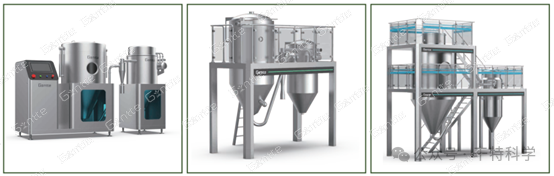
01 Low-temperature drying
The actual drying temperature can be lower than 30℃, with instantaneous drying and a heat exposure time shorter than 1 second. During the drying process, the structure of heat-sensitive drugs remains stable, and their activity is retained to the greatest extent.
02 Controllable granularity
The particle size of the powder is uniform and controllable. The product can achieve a precise particle size ranging from 2μm to 300μm, and the moisture content can be reduced to 1% to 10%.
03 High Production Efficiency
Continuous production, breaking through the limitations of batch production, enables continuous drying and material collection, with a yield as high as 95% to 99%.
04 Energy Conservation and Consumption Reduction
Low-energy consumption production can reduce energy consumption by 40% to 70% compared with traditional drying of heat-sensitive materials.
How to select the appropriate drying process based on the characteristics and quality requirements of the materials?
How to correlate processes, equipment, and prescriptions, and design a drying process to achieve better drying and granulation?
In the subsequent articles, the editor will continue to share the process and control points of different drying methods, as well as comparative studies and quality characterization of different processes, to help everyone choose the appropriate drying process. Stay tuned for more...
Contact Us
- Shanghai Gantte Technology Co., LTD
Mobile Phone: 15000805345
Tel: 021 - 37600082
Address: No. 358 Meinengda Rd, Songjiang District, Shanghai, China
Email: Xiangb@gantte.com